
A few weeks ago I made a hat. I used two different fabrics, a bottom weight twill and a medium weight plain weave. Interfacing needed to be attached to some of the pieces of each fabric. After carefully cutting out all my pattern pieces I fused the interfacing to the appropriate ones.
Everything was going well until I needed to attach an interfaced plain weave piece to a piece of twill that had no interfacing. All the pieces were the right size when I cut them out, but suddenly they no longer fit together. I preshrunk the interfacing and both types of fabric, but fusing the interfacing to the fabric caused it to shrink some more. The twill retained its size, but the plain weave pieces were suddenly far too small. I was able to salvage the project by trimming the pieces that did not shrink.
My instructor at MCTC taught me to fuse interfacing to fabric before cutting out pattern pieces, but both my instructor at Stout and the guide sheets in commercial patterns advise fusing the interfacing after the pieces are cut. I think my instructor at MCTC had the right idea. For everything I made since that hat I fused before cutting, and I have had no more shrinkage problems. This method requires a little more interfacing, but the stuff is cheap.
Saturday, June 19, 2010


Monday, June 14, 2010
Insulted at the fabric store
This morning I was at Jo-Ann Fabrics. The woman cutting my fabric recognized my shirt’s print. I bought the fabric for the shirt at Wal-Mart, but apparently Jo-Ann also sells that print. She asked, “Did someone make that shirt for you?” I am a man, so clearly I could not be the one who made the shirt.
I cannot boycott Jo-Ann Fabrics, but I will not return to that particular location.
I cannot boycott Jo-Ann Fabrics, but I will not return to that particular location.
Tuesday, June 1, 2010
Semester review, part 3: textiles
Textiles was my favorite class and also the one I found most difficult. After watching students at Minneapolis Community and Technical College struggle through their textiles class I knew it would not be easy, but I was still surprised at how much I had to learn. I thought the class would consist of memorizing many different types of fabrics. I certainly had to do that, but there was so much more. It is not enough to know what fibers a particular piece of fabric is made of, I need to know everything about those fibers.
Each week there were two lectures and one lab. I found the lectures fascinating, but unfortunately a lot of my classmates did not agree with me. I meticulously took detailed notes while others connected with their friends or tended their farms on Facebook. I studied, did all my homework, and got an A in the class. I suspect the farmers did not do quite so well.
The class covered five broad topics: serviceability concepts, fibers, yarns, structures, and finishes. Serviceability concepts use the properties of a fiber, yarn, fabric, or finish to describe a textile product’s suitability for a particular use. I need to be familiar with these concepts and be able to apply them to specific products in order to choose the correct textile for whatever I am making.
We spent nearly half the semester learning about fibers. I learned the properties of many natural, regenerated, and synthetic fibers. With the aid of a microscope and a book of matches I had to be able to determine if a fiber was natural, regenerated, or synthetic. If it was natural I had to be able to identify it, and if it was regenerated I had to be able to tell if it was cellulosic or protein (azlon). As I studied fibers I often thought that the class belonged in the chemistry department rather than apparel design.
Yarns was the shortest, and I thought easiest, part of the class. Yarns are filament or spun, plain or fancy. Identifying fancy yarns was the hardest part of this section, but it was not too difficult.
Fabrics may be one of three structures: weave, knit, or non-woven. I had the most fun learning about weaves. I can visualize how a loom works, and I had no trouble identifying specific weaves. I found knits quite confusing. I learned enough to identify different knits, but I cannot visualize how a knitting machine turns yarns into fabrics. I suspect that if I spent some time with a knitting machine it would make a lot more sense, but looking at diagrams, pictures, and videos of the machines did not help me. I thought non-wovens were boring, but it might have been that we were nearing the end of the semester and I was very busy with projects for other classes. I was mortified to learn that the doll outfits I thought I made out of felt were really made with needle punched fake felt. I have nothing against the fabric itself, I just do not like things that are not labeled truthfully.
Learning about finishes was interesting, but I thought the lab could have been more exciting. Rather than just looking at fabrics to identify the finish I would have liked to have applied a finish or two myself. Studying coloring techniques inspired me to tie-dye the shirt I made for my apparel construction class. Despite numerous warnings that I would be foolish to try it, I am sorely tempted to try combining muslin and lye to make mercerized cotton.
After learning about fibers, yarns, structures, and finishes I had to apply my knowledge to identify fabric samples and use the serviceability concepts to explain how the fabric should be used. Identifying samples was the hardest part of the class for me. I can look at a piece of fabric and tell you its fiber content, yarn type, structure, and finish, but I have a lot of trouble remembering fabric names.
The content of the class will be very useful for me, but it was the professor who made the class so much fun. My classmates at MCTC often complained about their textiles instructor, and they hated their class. I am glad I waited until I got to Stout to take the class. Textiles can be a painfully dull topic, but Dr. Rhee made it fun and exciting. I am looking forward to taking more of her classes.
Friday, May 28, 2010
Semester review, part 2: fashion industry class
Before the start of the semester I was excitedly looking forward to my fashion industry class. I know I want to become a designer, but I do not know exactly what it is I want to do as a designer. I know very little about the fashion industry, so I am not sure who I want to work for or what sort of job I want. I hoped this class would teach me what I needed to figure out what I want to do. It didn’t.
I wanted to learn about fashion companies and how the industry functions. The class was about how to run a company. I do not feel at all prepared to run a company. The class was taught by an instructor from the apparel design department, not one from the business department. I will be taking two business classes this summer and more in the coming semesters. Perhaps those classes will prepare me to run a company, but I do not want to be the boss. I just want to work for someone else, collect a regular paycheck, and be told what to do.
The apparel design department’s intro class is not required for transfer students, but I will be taking it next semester. The intro class covers a lot of the stuff I hoped to learn in the fashion industry class. Fashion industry was a required class, so I’ll just think of it as three credits closer to graduation.
Although I feel I did not benefit much from this class, I did have a lot of fun with the final project. It was a group project. We had to design a product and create a company to market it. I wanted to make national costume doll outfits to coincide with the World Cup, but the other members of my group did not like playing with dolls. One of the women in the group once saw an article about using fabric with piezoelectric nanowires to generate electricity, and she thought clothing that could be used to recharge cell phones would be a good idea. The technology does not work, but our instructor loved the idea.
For the project we needed in a binder describing our product and company, and we had to make a three minute presentation advertising the product. I was not happy about having to design a marketing scheme for a product that I know could not work, but I had a lot of fun with my sales pitch. Unfortunately the other members of the group edited out some of my best bits. I set a price for our product, then used the following explanation to justify that price:
The technology upon which this product is based does not in fact exist. Piezoelectric nanowires exist and can be used to generate electricity, but there is no known process for waterproofing the wires. Atmospheric humidity is enough to render the wires inoperable. Our project is a work of science fiction. There are no data to support our price estimates. With a great deal of fanfare, Daniel Cole pulled the numbers from his ass and declared them to be good.
I felt honesty is good, but I was overruled. My teacher did not see my price explanation. Perhaps that was best. My final grade for this class was an A.
Wednesday, May 26, 2010
Semester review, part 1: the other classes
The semester is finally over, and it is time for me to share with you what I learned. Two of the five classes I took this semester had nothing to do with apparel design, but were still required for my major. I will begin my review with my thoughts about those two classes.
SOC 110 – Introductory Sociology I expected this class to be inane and painfully dull. If it was not required I would not have even considered taking a social science class. My plan was to get it out of the way early so that as my apparel classes become more difficult over the upcoming semesters I will not have to spend time with other subjects. I was pleased to discover that my expectations were unfounded. The class was both interesting and fun, and the professor did a great job presenting the information to us. I always looked forward to the lectures. The class was not easy. I needed to spend a lot of time studying, and the paper and two essays I wrote took a lot of work. I am pleased to say the effort I devoted to this class paid off; I got an A.
None of the topics covered in the class related directly to apparel or fashion, but I was able to write my paper about the fashion industry. Early in the semester the professor gave me an article about fashion from a sociology journal. It was not for my paper; it was just something he thought I would find interesting. He was right. The article, “Fashion” by Georg Simmel, is about the driving forces in fashion. I agreed with what Simmel had to say, and what I found most fascinating about the article was when it was written. The language seemed a little archaic, but at first I thought that was just how sociologists wrote. I was more than two pages into the article before I realized how old it is. What Simmel wrote about fashion in 1904 is true today. Simmel suggested that the driving force in fashion is the desire of rich people to distinguish themselves from the rest of us. New fashion is expensive, so only rich people can afford it. Soon poor folk will be wearing cheap knock-offs, so the rich people need something new to wear.
Although I enjoyed this class a lot, I have no plans to take any more sociology or other social science classes. I will only take classes required for my major and minor.
PKG 100 – Packaging and Society I would not have taken this class had it not been required. Unlike sociology I expected this class would be both interesting and relevant to my major, but as was the case with sociology, my expectations were wrong. Part of marketing apparel is how it is packaged, and although this class is required for all apparel design students the packaging of apparel was never mentioned. The instructor spent the entire semester talking about how food and medicines are packaged. I got an A in the class, yet I feel I did not learn anything. Well, I did learn that the period following the fall of the Roman Empire was called the Dark Ages because the sky was dark for 800 years, but I suspect that may not be entirely accurate. The class is over, I got a good grade, and one more requirement has been taken care of, so I will not drone on about it any more
Tuesday, May 18, 2010
Choosing my concentration and minor
Apparel design students at UW-Stout must select one of three concentrations within the program. I have not yet picked mine. I do not need to declare a concentration now, but I should decide on one as soon as possible. Most of the apparel design classes are required for all three concentrations, but there are other classes that are required by only one or two of them. Any extra information I learn will be useful, but I want to graduate as soon as possible, so I need to spend as little time as possible in non-required classes.
The three concentrations are apparel design, apparel development, and apparel product management. I am leaning toward design, but my advisor seems to think product management would be better for me. The design concentration prepares students to become designers, while product management is more about running apparel companies. All three concentrations require a few business classes, but if I pick product management I will be only two classes away from a business minor.
I am taking the introductory apparel design class next semester. As a transfer student I am not required to take it, but I think it will be quite useful to me. I will learn a lot about the industry, and I expect the class will help me decide which concentration is right for me.
I have already fulfilled most of my general education requirements, so I may have time for two concentrations. Or I may choose a minor. I am considering Spanish, technical writing, and business administration. Learning another language can be quite useful. I will take a Spanish class next semester, and even if I choose to not minor in it I will take a few more. Quiero aprendar a hablar español. I would rather learn a Chinese dialect, but Stout does not offer any Chinese classes. The other two minors would be nice resume builders too. I will choose a concentration and possibly a minor before registering for spring, 2011 classes. The apparel design and business classes I chose for summer and fall are required for all three concentrations.
Sunday, May 16, 2010
One more shirt and my first portfolio page
The third garment I made for my apparel construction class this semester was a shirt. My instructor felt that the shirt was the most difficult project of the semester. I had a little experience making shirts and none making pants, so I had more difficulty with the pants. I think the hardest part of making a shirt isn’t the actual sewing, it is understanding what to do. I already knew how to make a shirt, so as my classmates struggled to figure out how to make plackets, collars, cuffs, and all the other odd bits I was able to concentrate on getting everything made well.
I think I did a very good job with this shirt. It is far from perfect, but I see consistent improvement with every shirt I make. I had a lot of trouble with sleeve plackets and cuffs on previous shirts, but now those two seem easy. My collar stands are getting better, but they still need a lot of work.
Unlike the previous two projects for my class, this one did not require a fit muslin. We did a tissue fit instead.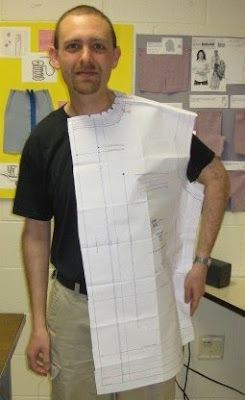 The torso fit well, and my pattern had neck sizes marked in inches, so those two areas presented no problems. I thought I would have to lengthen the sleeves, but after pinning my pattern to me my instructor said the sleeve length was good. I should have lengthened them. The sleeves on my first shirt were too short and I did not have enough fabric to make new ones. I was ahead of schedule, so instead of making giant cuffs I made a new shirt.
I need an unbleached muslin shirt for my fashion industry class. My plan was to make that shirt after I finished the broadcloth one for apparel construction, but after I gave up on the broadcloth shirt I decided to use the same shirt for both classes. I used a heavyweight muslin that looks quite nice for apparel.
I am not sure where the idea came from, but at some point I found myself thinking that as much as I liked my natural color shirt I would like it even more tie-dyed. Once an idea gets lodged in my head I cannot shake it. The local stores did not have a great selection of dyes, but I think the colors I chose work well together. I am almost done with an undyed shirt for fashion industry.

Every year the apparel design instructors at my school meet with industry representatives to evaluate the program. The most recent feedback they received was that Stout graduates are skilled in the technical areas of apparel design but have difficulty with presentation, communication, and technical writing. The department will try to work on those areas. Most classes will now require students to make some form of presentation. Instead of a final exam for apparel construction, we had to make portfolio pages and present them to the class.
I never made a portfolio page before, I do not know how to use the software usually used for portfolio pages, and there was only one brief lesson in class about how to make a portfolio. My pages for this class did not have to be up to professional standards; the purpose of this assignment was to introduce us to portfolios and presentations. I included photos of the shirt, samples of fabric and notions, and flat drawings of the shirt and some of its more difficult parts. I think my instructor was pleased with my portfolio. Tomorrow I get it back and find out what I did wrong.
I think I did a very good job with this shirt. It is far from perfect, but I see consistent improvement with every shirt I make. I had a lot of trouble with sleeve plackets and cuffs on previous shirts, but now those two seem easy. My collar stands are getting better, but they still need a lot of work.
Unlike the previous two projects for my class, this one did not require a fit muslin. We did a tissue fit instead.
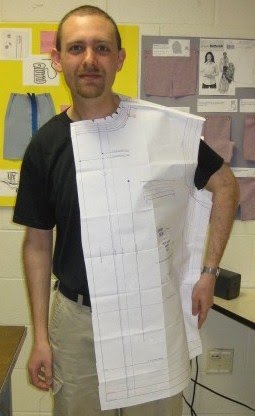 The torso fit well, and my pattern had neck sizes marked in inches, so those two areas presented no problems. I thought I would have to lengthen the sleeves, but after pinning my pattern to me my instructor said the sleeve length was good. I should have lengthened them. The sleeves on my first shirt were too short and I did not have enough fabric to make new ones. I was ahead of schedule, so instead of making giant cuffs I made a new shirt.
I need an unbleached muslin shirt for my fashion industry class. My plan was to make that shirt after I finished the broadcloth one for apparel construction, but after I gave up on the broadcloth shirt I decided to use the same shirt for both classes. I used a heavyweight muslin that looks quite nice for apparel.
I am not sure where the idea came from, but at some point I found myself thinking that as much as I liked my natural color shirt I would like it even more tie-dyed. Once an idea gets lodged in my head I cannot shake it. The local stores did not have a great selection of dyes, but I think the colors I chose work well together. I am almost done with an undyed shirt for fashion industry.

Every year the apparel design instructors at my school meet with industry representatives to evaluate the program. The most recent feedback they received was that Stout graduates are skilled in the technical areas of apparel design but have difficulty with presentation, communication, and technical writing. The department will try to work on those areas. Most classes will now require students to make some form of presentation. Instead of a final exam for apparel construction, we had to make portfolio pages and present them to the class.
I never made a portfolio page before, I do not know how to use the software usually used for portfolio pages, and there was only one brief lesson in class about how to make a portfolio. My pages for this class did not have to be up to professional standards; the purpose of this assignment was to introduce us to portfolios and presentations. I included photos of the shirt, samples of fabric and notions, and flat drawings of the shirt and some of its more difficult parts. I think my instructor was pleased with my portfolio. Tomorrow I get it back and find out what I did wrong.

Subscribe to:
Posts (Atom)